Are you trying to decide between an open and closed kitchen? The right layout affects how you cook, entertain, store food and move through your home every day.
An open kitchen can keep you connected to the living and dining areas. A closed kitchen provides more separation, wall space and privacy. A hybrid kitchen offers some of the benefits of both.
This guide focuses on choosing the right kitchen layout. For help organizing the complete project, including budgeting, appliances and construction stages, read our kitchen renovation planning guide.
Quick answer
Choose an open kitchen if connection, natural light and entertaining matter most. Choose a closed kitchen if you want more privacy, storage and control over cooking noise. Choose a hybrid layout if you want the flexibility to open or separate the kitchen when needed.
Start with how you use the kitchen
- How often do you cook large or aromatic meals?
- Do you entertain while preparing food?
- Do you need to supervise children from the kitchen?
- How much storage and appliance space do you need?
- Do you prefer to keep meal preparation out of view?
- Can the existing walls be changed safely and legally?
Open, Closed and Hybrid Kitchen Layouts
Open kitchen
Connected to the Living Space
An open kitchen has few or no full-height walls separating it from the dining or living area. The kitchen becomes part of a larger shared space and is usually organized around an island or peninsula.
Closed kitchen
A Separate Cooking Room
A closed kitchen is enclosed by walls and has one or more defined entrances. It provides separation from the main living spaces and usually offers more wall area for cabinets, appliances and storage.
Hybrid kitchen
Flexible Separation
A hybrid or broken-plan kitchen uses partial walls, pocket doors, glass partitions or a separate preparation kitchen. It can maintain visual connection while giving you more control over noise, clutter and cooking activity.
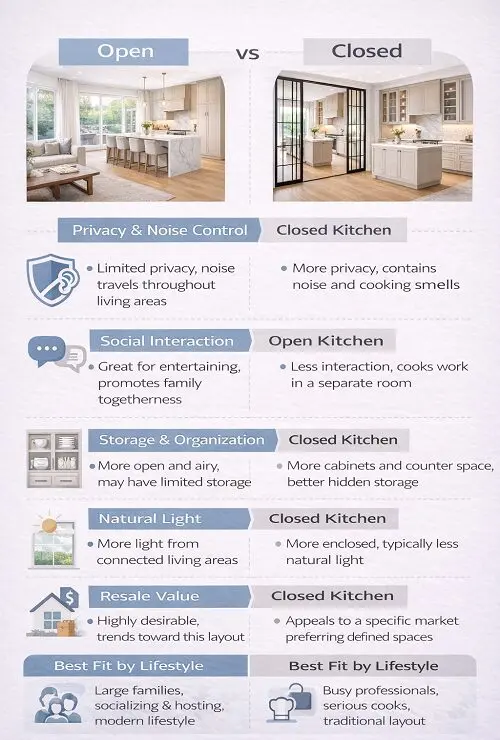
Open vs. Closed Kitchen Comparison
| Consideration | Open kitchen | Closed kitchen | Hybrid kitchen |
|---|---|---|---|
| Social connection | Strong connection to living and dining areas. | Cooking is more private and separate. | Can be connected or separated as needed. |
| Noise and aromas | Travel more easily into adjoining rooms. | Easier to contain behind walls and doors. | Dividers provide some control when closed. |
| Storage | May have less wall space for cabinets. | Usually provides more continuous cabinet walls. | Storage depends on the divider and room shape. |
| Natural light | Can share light from adjoining rooms. | Depends more on kitchen windows and lighting. | Glass or wide openings can preserve light. |
| Clutter | Visible from the main living space. | Can remain out of view while entertaining. | Can be hidden by closing doors or partitions. |
| Construction | Wall removal may require structural work. | May preserve more of the existing structure. | Custom doors and partitions add coordination. |
Benefits of an Open Kitchen Layout
An open kitchen works well for homeowners who want cooking, dining and relaxing to happen within one connected area. It allows the person preparing food to remain part of conversations and family activity.
An open kitchen may be right for you if:
- ✓ You regularly entertain while cooking.
- ✓ You want to supervise children from the kitchen.
- ✓ The kitchen receives limited natural light.
- ✓ You prefer informal dining around an island.
- ✓ You are comfortable keeping the kitchen visible.
Better Connection Between Rooms
Removing visual barriers can make it easier for people in the kitchen, dining room and living area to interact. This is useful during family meals, parties and busy mornings.
Shared Natural Light
An open layout may allow windows in one area to provide light across a larger part of the floor. The result depends on window direction, room depth and the placement of cabinets and tall appliances.
Flexible Entertaining Space
A large island or peninsula can support food preparation, casual meals, homework and conversations. Clear circulation around the island is important so seating does not block cooking or appliance access.

Challenges of an Open Kitchen
Cooking noise, aromas and visual clutter can move into the rest of the living space. Good ventilation and practical storage are especially important in an open kitchen.
The kitchen finishes must also work with the adjoining rooms. Flooring transitions, cabinet colours, lighting and furniture should feel connected without making every surface identical.
Plan storage before removing walls
Removing a wall may also remove upper cabinets, pantry space and appliance locations. Confirm where those functions will move before approving an open layout.
Benefits of a Closed Kitchen Layout
A closed kitchen provides a defined room for cooking and food preparation. It can be a practical choice for homeowners who cook often, want more storage or prefer to keep the working kitchen separate from formal areas.
A closed kitchen may be right for you if:
- ✓ You prepare large or aromatic meals regularly.
- ✓ You want more walls for cabinets and appliances.
- ✓ You prefer a quiet, focused cooking space.
- ✓ You entertain in a separate dining or living room.
- ✓ You want meal preparation kept out of view.
More Cabinet and Appliance Space
Full walls can provide room for tall pantry cabinets, wall ovens, refrigeration and countertop appliances. This can be helpful when the kitchen supports a large family or frequent cooking.
Greater Separation
Walls and doors can reduce the amount of cooking noise and visual activity entering the rest of the home. A strong range hood is still required because separation does not replace proper ventilation.
Independent Design
A closed kitchen can have its own colours, flooring and lighting without needing to match every adjoining room. This gives you more freedom to create a distinct atmosphere.

Challenges of a Closed Kitchen
The person cooking may feel separated from family and guests. A small closed kitchen can also feel dark or confined when it has limited windows or narrow entrances.
Wider doorways, interior glass, layered lighting and a direct connection to the dining room can make a closed kitchen feel more welcoming without removing every wall.
When a Hybrid Kitchen Works Best
A hybrid kitchen is useful when you like the connection of an open layout but still want the option to separate cooking from the rest of the home.
The divider should be treated as part of the architecture rather than an afterthought. Door tracks, pockets, glass panels and surrounding millwork need enough space to operate properly.
Pocket Doors
Pocket doors slide into the wall and disappear when open. They require a clear wall cavity without conflicting plumbing, electrical or structural elements.
Glass Partitions
Glass can maintain light and sightlines while providing some separation. Clear, fluted or framed glass can be selected to suit the style of the home.
Partial Walls
A half-wall or wide framed opening can define the kitchen without completely closing it off. The wall may also provide space for storage, serving surfaces or electrical outlets.
Separate Preparation Kitchen
A secondary preparation kitchen or scullery allows the main kitchen to remain open while messier cooking, storage and cleanup happen in a separate room.
Which Kitchen Layout Is Best for Your Home?
The best layout is the one that works with your household and the existing architecture. A popular design is not automatically the right design for every Toronto home.
Choose based on your main priority
Connection and entertaining
An open or hybrid kitchen will usually provide the strongest connection.
Serious cooking and storage
A closed kitchen or open kitchen with a scullery may work better.
Natural light
An open layout or glass partition can allow light to move between rooms.
Privacy and formal entertaining
A closed or hybrid kitchen can keep meal preparation separate.
Changing household needs
A hybrid layout provides the most flexibility over time.
Review the Existing Structure First
Opening a kitchen is not always as simple as removing a wall. The wall may support floors or the roof, contain plumbing and electrical lines or provide space for heating and cooling systems.
Structural changes may require drawings, engineering and a building permit. The City of Toronto provides current guidance on its building permit requirements page.
Do not remove a wall before it is assessed
A qualified professional should confirm whether the wall is structural and identify any services running through it before demolition begins.
How to Plan the New Kitchen Layout
Record your daily routine
Consider who cooks, where groceries are stored, how meals are served and where people naturally gather.
Measure the existing space
Record windows, doors, ceiling heights, wall lengths, appliance locations and connections to adjoining rooms.
Confirm structural limitations
Identify load-bearing walls, plumbing stacks, ventilation routes and electrical requirements before selecting a layout.
Plan work zones and storage
Make sure food storage, preparation, cooking and cleanup areas connect without creating crowded walkways.
Compare the complete cost
Include structural work, cabinetry, appliances, flooring, lighting, ventilation and finishes when comparing layout options.
For additional layout, lighting and storage ideas, review our guide to the best kitchen remodel ideas.
You can also review the main factors affecting kitchen renovation costs in Toronto before choosing a design.
A coordinated design-build process can help connect the layout, engineering, permits, materials and construction plan.
Frequently Asked Questions
Which kitchen layout is best for a small Toronto home?
An open layout can make a small home feel more connected, but it may reduce cabinet space. A compact hybrid layout with a wide opening, peninsula or glass partition can provide connection while preserving storage.
Is an open kitchen better for resale value?
There is no guaranteed resale increase from choosing an open kitchen. Buyers value different layouts, so the quality, function and condition of the completed kitchen are often more important than openness alone.
Can I remove a wall to create an open kitchen?
Possibly. The wall must first be checked for structural, plumbing, electrical and mechanical functions. Structural changes may require engineering drawings and a building permit.
What is a hybrid kitchen layout?
A hybrid kitchen combines openness with optional separation. It may use pocket doors, sliding glass partitions, partial walls or a separate preparation kitchen.
Which layout is best for controlling cooking smells?
A closed kitchen generally provides more separation, but every layout still needs a properly sized and installed ventilation system. Doors and walls cannot replace an effective range hood.
How do I choose between an open and closed kitchen?
Consider how often you cook, how you entertain, how much storage you need and whether you want the kitchen visible from the main living areas. The existing structure and renovation budget will also affect the decision.
View Odima’s custom home portfolio for examples of different kitchen and living-space designs.
Planning a new kitchen layout?
Odima Construction can help you compare layout options and coordinate the design with your home’s structure, budget and daily needs.